Showing posts with label yoga. Show all posts

Thursday, May 07, 2009

Yog Parichay - Introduction to Yoga

The word 'YOG' is coined by the root word in sanskrit 'YUJ' . And the word yoga means ..to combine something.So while doing yoga we combine our outer body postures with the internal organs and glands.Also ..every where in ancient yoga training it is stated again and again with impression that we have to control our breath(may b..hold it in,or out ..or breathing slowly ..as stated there) and also to control thinking process going in our brains.Thats why just before every 'Asana' it is a norm to first sit calmly for half a min. and breath deeply than we usually do..and close ur eyes and focus your brain to the present and whatever is happening just in this second.So yoga is just not a technique to keep your self healthy or to get in shape by loosing fat..but the aim of yoga goes beyond all these first after effects.The aim of yoga is to reach the highest level of our existance :)
The yoga has eight main..or basic chapters ..or we may assume like..the Yoga is classified primarily in eight parts !Thats why the term comes in ancient books of Yoga..'Ashtaang yoga'.
This term contains the word 'Asht' mean eigth...and 'Ang' means parts..most hindi and sanskrit words can b understood with this simple technique too..just try to break the words in two or three basic words and you get the intention of framing the word.So scientific is this sanskrit language is..that you get a complete definition of a word just in the word itself !Thats like a perfectly organised system with no loopholes and no scope left for further developments.Dont know who made all these knowledge available to indians..were those Aryans or the Dravidians...but this is for sure..india was the mainland where all such higher sciences were discovered and evolved .

So here i mention the eight basic parts of yoga called the 'Ashtaang yog'.We will get an expalination on all these one by one in the next post.

1. Yamm or yumm
2. Niyam
3. Aasana (mostly ppl think this is what yoga is..but it is just a part of yoga :D)
4. Pranaayam
5. Pratyaahar
6. Dhaarna
7. Dhyaan
8. Samaadhi


योग शब्द 'युज ' धातु से बना है / ' योग ' का शाब्दिक अर्थ ' मिलान या संधान ' होता है /योग के हर आसन को करते समय ये हमेशा कहा जाता है की पहले आधा मिनिट के लिए शांत मन से आराम से बैठिये और गहरी साँस लीजिये और मनन को वर्तमान में ले आयें ..यानि के कहने का मतलब ये है की योग केवल शरीर को स्वस्थ रखने का साधन मात्र नही है अपितु शरीर को स्वस्थ रखना तो पहली सीढ़ी है जिसपर हम पहुचते हैं योग करते हुए /योग इस से भी बहुत आगे की बात को साधने के लिए है वास्तव में /आत्मा और परमात्मा का संधान योग द्वारा ही होता है भारत के ऋषि - मुनियों ने तन ,मनन ,और प्राण की शुद्धी एवं परमात्मा को पाने के लिए के लिए योग के 8 अंगों का निर्देश दिया है /इन्हें अष्टांग योग ' कहा जाता है /हम भारतीय तो अच्छी तरह जानते हैं इस बात को की किसी भी हिन्दी या संस्कृत शब्द को समझने के लिए बस उसका संधि विच्छेद कर दीजिये :)
आपको अष्टांग योग के आठों अंग तो अभी बता देते हैं यहीं..मगर इनके बारे में विस्तार से अगली पोस्ट में बात की जायेगी /
ये आठ अंग हैं -
१। यम्
२। नियम
३। आसन (जबकि हम केवल आसन हो ही योग समझते हैं :D)
४। प्राणायाम
५। प्रत्याहार
६। धारणा
७। ध्यान
८। समाधि

Friday, September 14, 2007

The mantras chanted during performing SURYANAMASKAR

सुर्यनामस्कर करते समय निम्नलिखित प्रार्थना करने के बाद हर आसन के साथ सूर्यदेव के विभिन्न
नामो का उच्चारण करके उन्हें मन ही मन प्रणाम करें
While doing suryanamaskar,one should chant the following mantra/prayer and then at each specific posture one should chant the different sanskrit synonyms of sun,the lord.

The prayer

ll ध्येय: सदा सवितृ मंडल मध्यवर्ती
नारायण: सर्सिजासन संन्निविष्ट:
केयुर्वान मकर कुंडल वान किरीटी
हारी हिरण्यमयवपुर्धॄतशङख्चक्रः ll
Praising 12 Synonyms of The Sun in sanskrit
(all spellings correct)
ॐ मित्राय नम:
ॐ रवये नम:
ॐ सूर्याय नम:
ॐ भानवे नम:
ॐ खगाय नम:
ॐ पूष्णे नम:
ॐ हिरण्यगर्भाय नम:
ॐ मरीचये नम:
ॐ अदित्याय नम:
ॐ सवित्रे नम:
ॐ अर्काय नम:
ॐ भास्कराय नम:
good luck

Tuesday, July 10, 2007

The Pranayama,positive breathing


Two gurus from India are emphasising over pranayam these days.One is Sri Sri Ravishankar ji,and Shri Ramdevji Maharaj.
A NEW spiritual revolution seems to be sweeping through people's living rooms. In this 24x7 era, everything is home delivered, now including your daily fix of spirituality. Riding on the satellite channel route, spirituality has grown by leaps and bounds, creating a new breed of couch potatoes (or is it couch devotees)!A program that has captured everyone's imagination in India as well as the Indian Diaspora (as this particular TV channel's programs are also distributed abroad), is Swami Ramdevji's Divya Yog program on Aastha TV. Aired at 5 am in the morning (the late risers can catch the repeat episode at 8.30 pm), it has turned many an early walker into an early TV gazer.In his rapid-fire manner, Ramdevji, of the Divya Yog Mandir Trust, belts out cure after cure for almost all diseases afflicting mankind. Very simply put, they all begin and end at the proper breathing techniques. In this age when short, snappy self-help books outsell classics, it is no surprise that there is a "technique" to breathing too.The program is probably one with the highest TRP ratings on the channel or indeed across channels. And, one of the reasons is because there are many ordinary folk who vouch for the remedies the 48-year old Ramdevji prescribes. Some are even beginning to call him Mahatma, for while most other 'gurus' exhort people to attend their camps and pay huge amounts to do basic meditation courses, Ramdevji's advice is for all – those who attend his camps or those who wish to watch him on TV.Swami Ramdevji believes that the secret to a healthy life is right living and by doing so we can easily beat most of the illnesses that afflict mankind. In his orange robes, jet-black, long flowing hair and beard, lean physique and oodles of energy, Ramdevji makes quite an impression. Extremely vociferous in his opinions, he uses public platforms to express the harmful effects of the banes of westernization like colas and fast food, going to the extreme of calling 'Leher Pepsi', 'Zeher Pepsi' (poison). He advocates the use of Indian-made products versus the wares dished out by MNCs. It is thanks to these scathing remarks that he has earned the wrath of several people and organizations. In fact, following threatening calls he has been granted 'Z-cover Security' (top-level security in India, which is granted to only VIPs and other very senior politicians) by the Indian government, says Ravi Kumar Rana who looks after the running of the ashram's activities, including sales of Ayurvedic medicines, in Vashi, New Bombay.
Ramdevji's biggest contribution to humanity has been demystifying Yoga and Pranayam (breathing technique). He asserts that apart from diseases connected to the bones, the rest can be cured by practicing Pranayam."Ailments like obesity, cardiac troubles, asthma, gastric problems, cholesterol and diabetes cannot be solved without the help of Pranayam," says Swami Ramdevji. He also goes on to add that "doing Yoga is also completely beneficial if it is done in conjunction with Pranayam. "Giving his own example, he says that in his childhood he was afflicted by paralysis of the left side which he cured himself thanks to daily practice of Pranayam. Pranayam is as old as Yoga, but Ramdevji has created a social stir by bringing it to the limelight. Though its origin is shrouded in antiquity, it was organized in a definite system by Maharishi Patanjali in his treatise "Yoga Darshana" (Philosophy of Yoga) or "Yoga Sutra" (Aphorisms on Yoga) as it is popularly known. While so far most of the focus was on Yogasanas (Yoga exercises), this unique and ancient breathing technique was not given much importance. Ramdevji says that in his life he has discovered that if practiced for a long duration of time, it has the power to overpower and counteract several illnesses, apart from rejuvenating the body.Keeping this in mind he advocates seven types of Pranayam techniques along with a set of Yogasanas for daily living. Some of these most popular ones are Bhastrika, Anulom-Vilom, Brahmri and Kapalbhaati. These techniques have become so popular that their names are on everyone's lips. Kapalbhaati has become the most famous mantra for those wishing to reduce their weight. And, more so as the visual demonstration (on TV) is extremely impressive - air being taken in through the nostrils and thrown out by pushing the stomach in.Ramdevji explains that Pranayam follows a scientific method. While the 'breathing-in' technique rejuvenates the tissues of the body and supplies more oxygen to them, the 'breathing out' technique churns out the toxins from the body.Somewhat dismissive of modern allopathic method, Ramdevji says these are good only in case of emergencies. Besides, they can't really cure chronic ailments, like diabetes or high blood pressure, only contain them. But, Pranayam is so effective that not only does it cure them (ailments), it also has no side effects. Day by day his popularity is soaring. Not only do common folk throng to his camps or are loyal viewers of his program, but also politicians, actors, industrialists and other powerful people who seek his advice. In fact, he has even held a special camp at the Presidential estate in Delhi, at Rashtrapati Bhavan at the behest of the President APJ Abdul Kalam.
Ramdevji follows a stringent daily schedule. He gets up in the wee hours of the morning at 3 am and then does Pranayam for over an hour. By 5 am he is at the hour plus Yoga Camp. After the camp between 7.30 and 8.30 he again devotes time to Yoga. During the day he spends time in meeting people, writing and of course practicing Yoga and Pranayam. He is an avid writer and has written several books on the benefits of Yoga and Ayurveda like 'Yog Sadhana Va Yog Chikitsa Rahasya' and 'Pranayam Rahasya'.He goes to bed by 10 pm and apart from these five hours of sleep doesn't sleep at all during the day. His diet consists of fruits, dry fruits, some green vegetables and milk.Ramdevji Early lifeAlthough pretty vocal in his TV programs, surprisingly Ramdevji doesn't like to dwell much on his early life. He believes that after a person becomes a sanyasi (somebody who has given up the life of a householder and stepped on to the spiritual path) there is no distinction between the family of his birth and the general public. For a true sanyasi the entire human race becomes a family. Keeping this in mind, Ramdevji doesn't interact much with the family of his birth, which include his parents and a brother.Ramdevji was born into an agriculturalist family from Gujarat. In school, he realized he was seeking something beyond the ordinary. In his own words he says that "by the time I was 14, apart from the works of Maharishi Dayanand Sarasvati, I had read all the works of Indian literature." This inspired him to seek further spiritual knowledge and study the Vedas in greater detail. Thus, at a very young age of 15-16, he left his home and joined the gurukul (residential school) of Haryana-based Acharya Baldevji Maharaj who taught the youngster Panini's Sanskrit Grammar and imparted the knowledge of the ancient Indian texts like the Vedas and Upanishads.For a short while he also stayed at the ashram of Dharamveerji Maharaj in Kishangarh Ghaseda, about 8 kms from Rewari in Haryana. Currently the Divya Yog Trust operates free Vidhyateertha Gurukul, a completely residential school. The school, spread over a huge area in the midst of nature, aims at providing a combination of modern and traditional knowledge for the all round mental and physical development of its students.After spending time with Dharamveerji Maharaj, Ramdevji moved on to the Himalayas, visiting the various ashrams nestled in the mountains. This is where he came under the influence of several philosophies and learnt about Yoga and meditation.It was while practicing Yoga in the caves of the mountains near the Gangotri glacier that he came in contact with his current co-workers Acharya Balkrishnaji and Acharya Karamveerji. At the same place he also met Acharya Muktanandji and Acharya Virendraji.

Thursday, July 05, 2007

Suryanamaskar,one among the essential yogas.


सूर्यनमस्कार अर्थात् भगवान सूर्यनारायण की वंदना । आयिये हम इस 'आसनों के सम्राट' का अलंकरण पाने वाले ,सर्वरोग-हर आसन के बारे मे कुछ और जानें । यह अत्यंत प्राचीन भारतीय व्यायाम-पद्धति है । प्रात:काल पूर्व दिशा में खड़े रहकर शांत चित्त से भगवान सूर्यनारायण कि स्तुति करते-करते सूर्यनमस्कार किया जाता है ।
इसे हमेशा खुली जगह और स्वच्छ जगह मे किया जाना चाहिऐ । कभी भी इस आसन को (..किसी भी आसन को ) आप अपनी क्षमता से अधिक नही करें ।


The real attention which is to be given while doing sheershasan sequence is the period when you have to inhale and the time/posture during which you have to exhale.In next paragraph i m going to explain this in some detail,though its you to grasp whats written here slowly as you practise and get aquainted with the right technique of doing.


1. Namaskar - salute. Standing with the feet together in tadasana, the mountain pose.


2. Chandraasan - crescent moon pose. Inhale, raise arms above the head, extend the spine backwards.

3. Hastapadaasan - bending pose. Begin exhale, bending forward from the waist, place hands on the floor, relax head and neck.

4. Surya Darshan - sun gaze. Inhale, stretch the right leg behind in a big backward step, resting on the toes. Bend your back knee to the floor with your weight on your left foot and arch the spine backwards.

5. Adho Mukha Svasana - downward facing dog pose. Exhale, step left foot back in line with right, liftthe hips up.

6. Sashtang dandawat - lie down. Put the knees down first, then the chest to the floor. See that the 8 parts of the body are touching the floor: two hands, the chest, the chin or forehead, two knees and two feet. Sashtang means 8 limbs and dandawat means paying homage by touching the floor.

7. Bhujangaasan - cobra pose. Lower the pelvis and abdomen to the floor. Inhale and stretch toes and legs, raise the head slowly. Arch the spine and neck and look up. Keep legs together and elbows alongside the body.

8. Adho Mukha Svasana. Exhale back to downward facing dog.

9. Surya Darshan. Inhale and bring the right foot forward and assume pose #4.

10. Hastapadaasan. Exhale and bring the left foot forward, to pose #3.

11. Chandraasan. Inhale and return to pose #2.

12. Namaskar. Exhale and stand erect.


All steps are to b done with a slow and comfortable pace.Also inhale and exhaling should also b slower than ur usual freq.

Monday, May 14, 2007

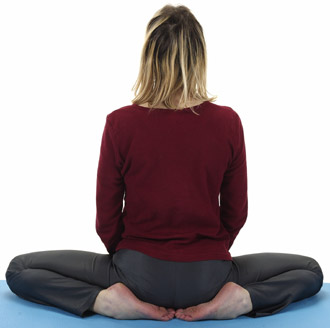
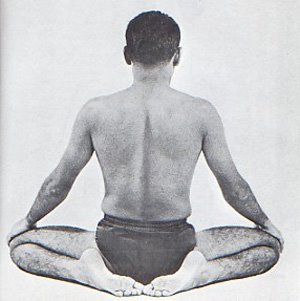
V-A-J-R-A-S-A-N :: The ONLY yoga posture which can b performed just after taking the meal


यह आसन कहलाता है वज्रासन । यह योग के प्रारम्भिक आसनों मे से एक है । इसे करने से पैरो कि शिराये सुदृढ़ होती है और भोजन का पाचन अच्छी तरह से हो जता है । यही एकमात्र आसन है जिसको कि भोजन के तुरंत पश्चात् करने मे लाभ है ।

This yoga posture is exceptionally useful in the proper secretion of all digestive juices.It also initiates motion in the intestine muscles.This asan strenghtens the muscles and tendents of legs and is also best for overall spine health.